 ecchelmet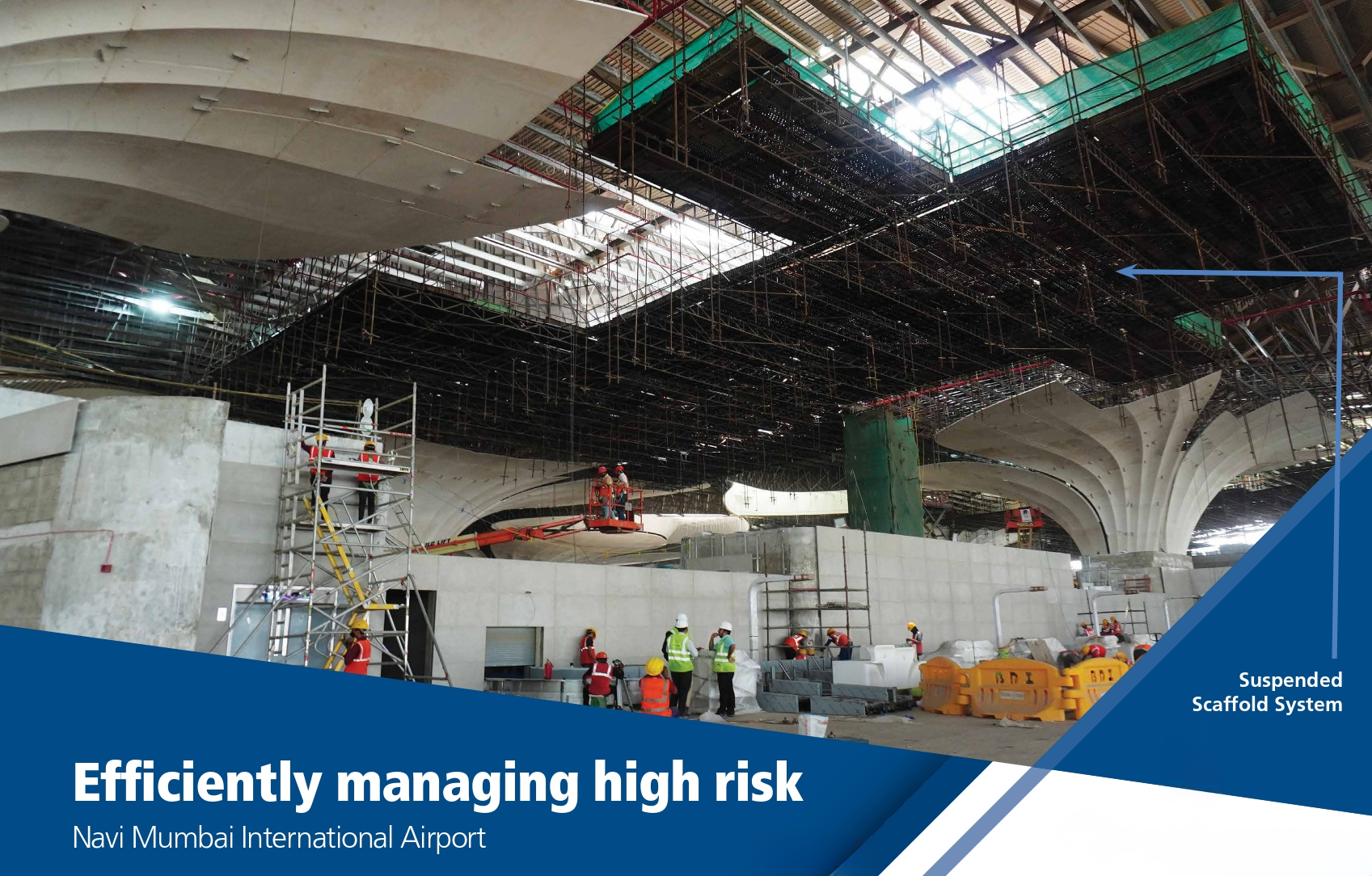
Executing the challenging Navi Mumbai International Airport project has been a high-stakes race against the clock, defined by unprecedented scale, speed, and complexity. Several tasks have demanded the team, led by Suman Chanda, TFL Head, and Rajesh Pachlot, Project Director, to make engineering choices carrying high risk, but a steadfast commitment to safety and innovative engineering have held them in good stead to eliminate the hazards and maintain progress.

The forecourt area was a chaotic, highaltitude symphony, for structural steel had to be erected to a height of 16 m, with teams busy with concrete shuttering directly beneath in the line of fire. We introduced a suspended scaffold system, with the working platform placed at a height of 16 m, erected using MEWPs to mitigate fall risks.
Santhosh Bhaskar
TFL EHS Head

The towering divide
“The forecourt area was a chaotic, high-altitude symphony, for structural steel had to be erected to a height of 16 m, with teams busy with concrete shuttering directly beneath in the line of fire,” says Santhosh Bhaskar, TFL EHS Head, with a worried shake of his head. Traditionally, the entire area would have been cordoned off with strict permits and administrative controls, but that would have thrown deadlines haywire and Santhosh was only too aware of the risks involved; therefore, as a team, they chose to eliminate the risk rather than manage it.
A team of formwork experts, structural engineers, and EHS professionals put their heads together and came up with a solution that addressed all of the team’s issues. “We introduced a suspended scaffold system, with the working platform placed at a height of 16 m, erected using Mobile Elevated Work Platforms (MEWPs) to mitigate fall risks,” reveals Santhosh.
“This was not merely a temporary barrier; it was a substitute for the hazard itself, for by installing a massive temporary floor – a network of 58,000 sq. m of suspended scaffolds – we physically separated the multilevel operations,” explains Rohit Patil, Construction Manager – Civil. “While the high-altitude steel workers had a secure platform to carry out their tasks, the workers below, completely shielded, continued with their concreting, shuttering, reinforcement, and structural steel activities.” Not only did the team overcome a serious safety issue, but by multi-tasking, they successfully kept up with the stiff asking rate to deliver the airport on time.
The 30 cm rift
“The façade of the Air Control Tower brought with it a challenge of installing 64 unitized glass panels, each measuring 4.7 × 1.2 m, weighing 700 kg,” mentions Jayanta Karmakar, Senior Manager – EHS. “These were enormous, fragile panels that had to be installed at a peculiar 17-degree angle inwardly inclined.” Although the initial plan was to use conventional overhead crane cleats for installation, the 30 cm projection of the Level 6 slab over the Level 5 slab made it extremely risky with the danger of the cranes clashing with the slab edge. “Manual installation was not an option either, as the workers would have to physically pull and place the 700 kg panels, risking injury or a catastrophic drop,” explains Vinayak D Patil, Manager – EHS. The other option to order a specialized, off-the-shelf lifting rig would have cost lakhs, increased lead times, and crippled their schedules.
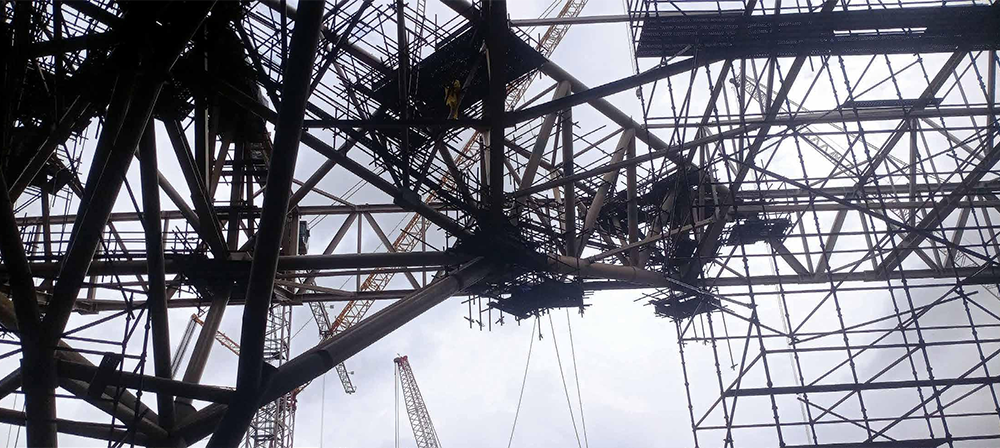
Suspended Scaffold System
The façade brought with it a challenge of installing 64 unitized glass panels, each measuring 4.7 × 1.2 m, weighing 700 kg. Designed with a 4 m span, our rig provided a precise 2 m clearance around the slab edge, while a counterloading mechanism provided the required 17-degree inclination.
Jayanta Karmakar
Senior Manager – EHS
With none of these options feasible, the team strategically chose to build their own solution. After multiple discussions, a custom lifting rig was proposed. “Designed with a 4 m span, our rig provided a precise 2 m clearance around the slab edge, while a counter-loading mechanism provided the required 17-degree inclination,” elaborates Jayanta. “By precisely guiding the panel, the design saved the workers from having to manually pull the panels laterally.”
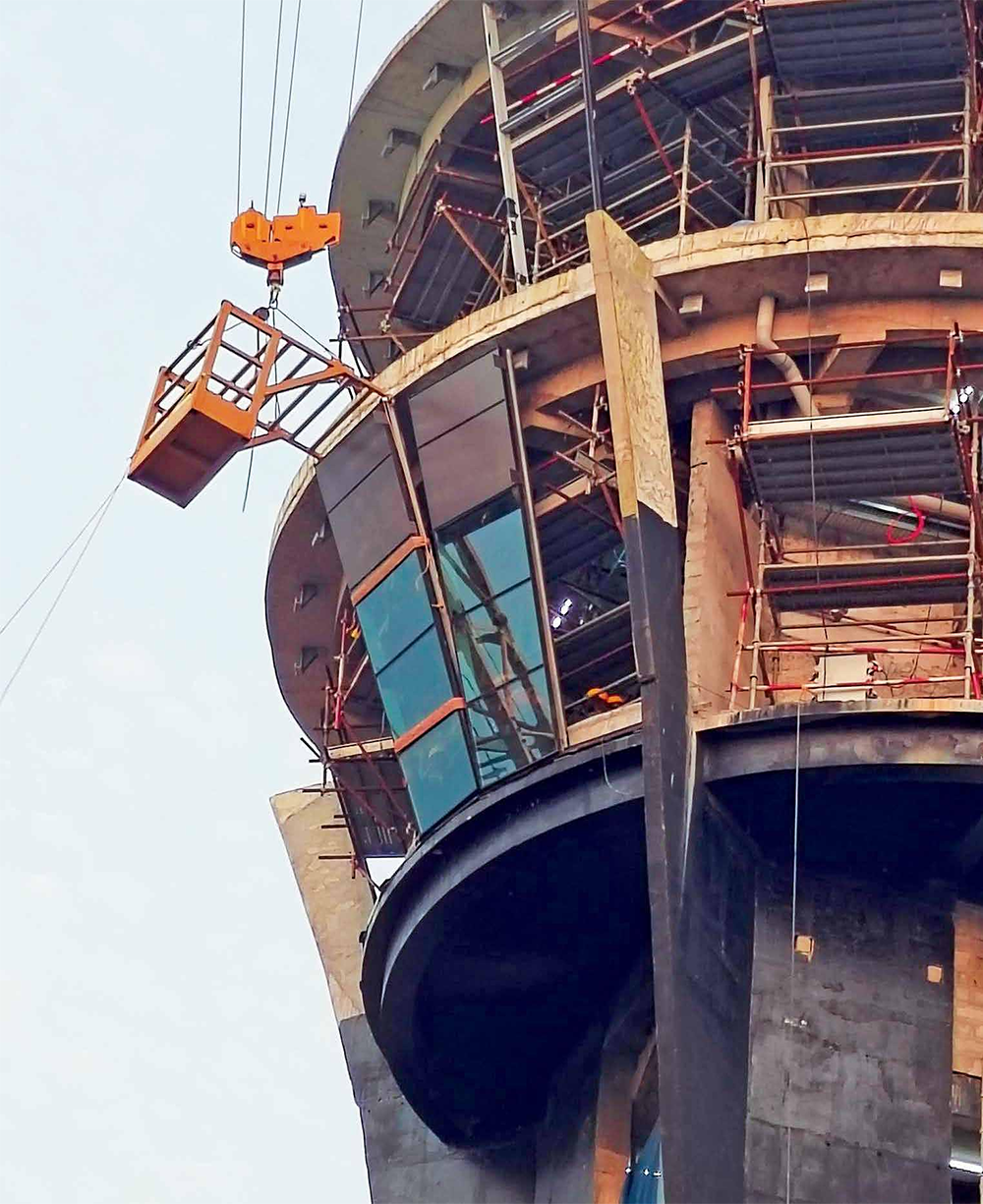
Façade erection with the custom lifting rig
The impact
After testing and having it certified by a competent third party for load-bearing capacity, the rig was pressed into service and proved to be an out-and-out winner – eliminating procurement delays, saving costs, and enhancing safety.
“All 64 panels were installed safely, precisely, and in record time, ahead of the baseline schedule,” smiles Santhosh. “This is a true testimony that innovative solutions emerge at the intersection of diverse expertise.” By refusing to accept conventional limitations and investing in engineering solutions that eliminate hazards, Santhosh & team have indeed added yet another feather in their cap.